
State of AI Executive Assistants 2026

Anmol Singh
• • 7 min read
All your tools. One intelligent assistant.
Your AI executive assistant that plans, organizes, and acts for you across every tool you use.
Half of employed Americans now use AI at work at least a few times a year, up from 46% just one quarter earlier (Gallup, January 2026). That growth has pulled a new software category into the mainstream: the AI executive assistant — a single AI layer meant to triage email, run a calendar, draft replies, and increasingly act across WhatsApp, phone calls, and the desktop itself.
We compared six of the category's most-searched products — Sintra, alfred_, Simular, Otto, Saner, and Dume — pulling pricing and feature claims directly from each vendor's own pricing page and product documentation, then cross-referenced adoption and market-growth figures against independent research from Gallup, Microsoft, and Fortune Business Insights. Here is what the AI executive assistant market actually looks like, priced and compared line by line, as of late July 2026.
Key Takeaways
- Half of employed Americans (50%) used AI at work at least a few times in Q1 2026, up from 46% in Q4 2025 and more than double the rate from three years earlier (Gallup, January 2026).
- Monthly pricing across six leading AI executive assistant products spans from $0 to $97: Dume and Saner offer free-forever tiers, alfred_ holds a flat $24.99/month, and all-in-one AI-persona bundles like Sintra run $48.50–$97/month (vendor pricing pages, July 2026).
- Only one of the six products compared — Dume — lets users choose the underlying AI model (GPT-5, Gemini, Kimi, Mistral, or Perplexity); the other five run on a single, fixed model stack set by the vendor.
- Otto breaks from subscription pricing entirely, selling a $599 one-time, always-on hardware device instead of a monthly seat (myotto.ai, 2026).
- Adding sourced original statistics to a page can lift its visibility in AI-generated answers by up to 40%, making original research one of the highest-leverage levers for AI-answer-engine citation (Aggarwal et al., “GEO: Generative Engine Optimization,” KDD 2024).
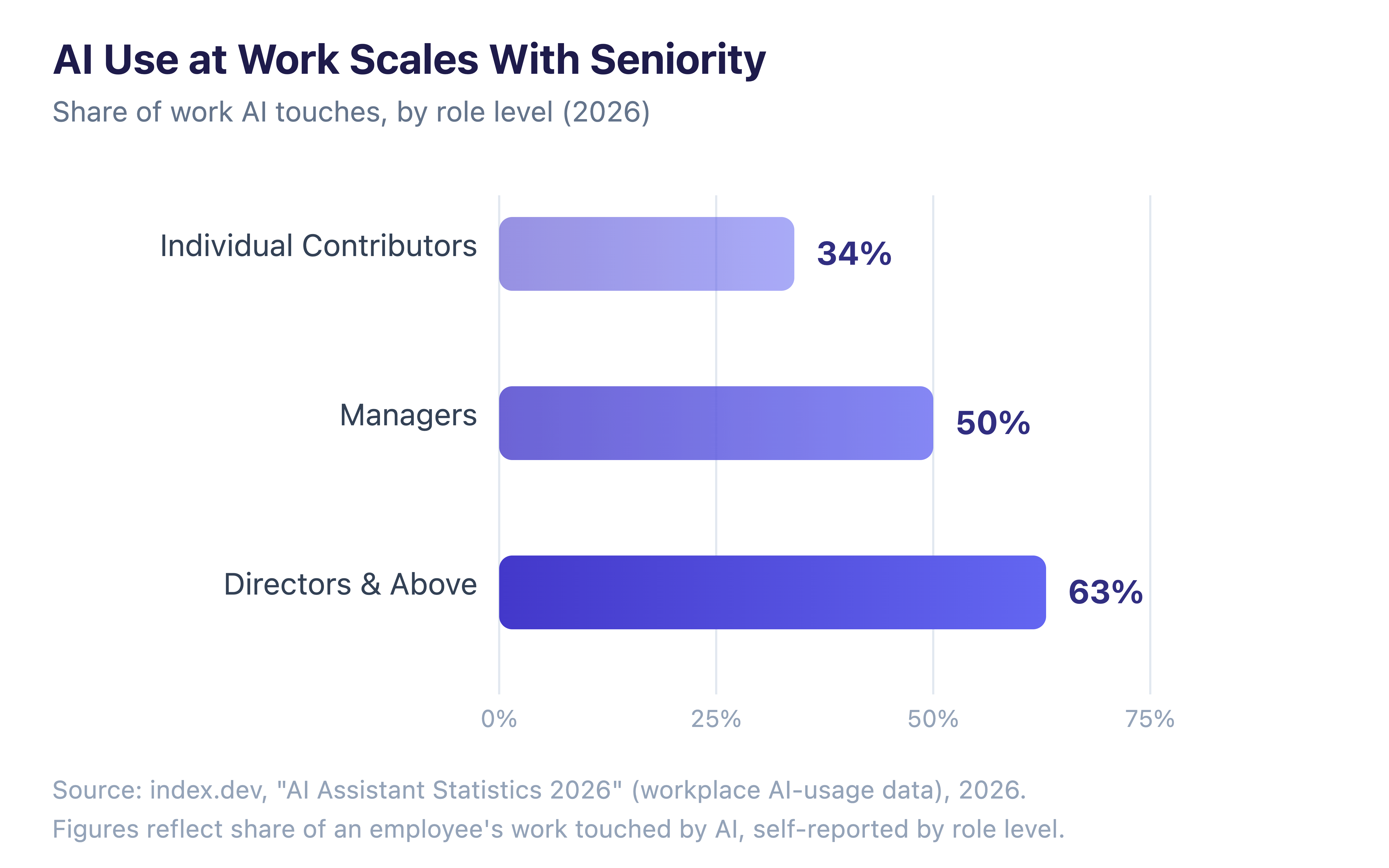
- AI use at work still scales sharply with seniority: individual contributors report AI touches 34% of their work, versus 50% for managers and 63% for directors and above (index.dev workplace AI-usage data, 2026).
How Big Is the AI Executive Assistant Market in 2026?
The broader AI assistant software market is projected to grow from about $11.87 billion in 2026 to $43.9 billion by 2034, a compound annual growth rate near 17.76% (Fortune Business Insights, 2026). Adoption is climbing in step with that growth: half of employed Americans (50%) now use AI in their job at least a few times a year, up from 46% the previous quarter and more than double the share from three years ago (Gallup, January 2026). Usage is no longer occasional experimentation — 13% of employees use AI daily and 28% use it a few times a week or more, per the same survey.
That volume of daily use is the exact wedge the AI executive assistant category is built on. Rather than opening a chat window for each task, users delegate an ongoing role — inbox, calendar, follow-ups — to a single standing assistant. It's a different pitch than a general chatbot, which is why six meaningfully different products, from a single-channel email specialist to a one-time-purchase hardware device, are now competing for the same buyer.
What Do AI Executive Assistants Cost in 2026?
Monthly pricing across the six products we compared ranges from completely free to $97, depending on whether the vendor sells a single specialist tool, a bundle of AI personas, or a physical device (vendor pricing pages, verified July 2026). Two of six — Dume and Saner — offer a genuine free-forever tier, while alfred_, the sole email-and-calendar specialist in the group, holds to one flat rate with no tiers at all.
| Product | Entry price | Free tier | Top published plan | Model / hardware note |
|---|---|---|---|---|
| Sintra | $39/mo for one AI helper; $48.50–$97/mo for the full 12-helper Sintra X bundle | No (14-day money-back guarantee only) | $97/mo (1-month plan) or $15.60/mo on the 12-month plan | Runs on Claude 4.5 Sonnet; 12 fixed personas including “Vizzy,” its executive-assistant helper (sintra.ai/pricing, 2026) |
| alfred_ | $24.99/mo flat | No (7-day free trial, cancel anytime) | $29.99/seat/mo (Team plan, 2-seat minimum) | Single fixed model stack; works inside Gmail, Outlook, and SMS only (get-alfred.ai, 2026) |
| Simular | $0/mo (Free plan) | Yes | $19.99/device/mo Premium + $39.99/device/mo Server add-on (200 agent-hours, then $0.10/agent-hour) | Cloud desktop agent “Sai” operating in an isolated virtual machine (simular.ai, 2026) |
| Otto | $599 one-time hardware purchase | N/A — one-time purchase, not a subscription | $799 (16GB/512GB configuration) | Physical always-on device; $29/mo for app access or pay-as-you-go cloud model costs (myotto.ai, 2026) |
| Saner | Free | Yes | $8/mo (Starter) | ADHD-focused personal organizer built around a single assistant, “Skai” (saner.ai, 2026) |
| Dume | Free forever | Yes | $33/mo, or $16.50/mo billed yearly (MAX plan) | Choice of GPT-5, Gemini, Kimi, Mistral, or Perplexity; WhatsApp and phone-call control (dume.ai/pricing, 2026) |
Pricing compiled from each vendor's public pricing page as of July 2026. Promotional and annual discounts change frequently and should be reverified before purchase decisions.
The spread reflects three different business models rather than three tiers of the same product. Sintra and Dume price a platform of many AI personas or agents; alfred_ prices deep specialization in a single job; Otto prices hardware you own outright instead of a seat you rent every month. Comparing sticker price alone is misleading until you first decide which of those three models fits how you actually want to delegate work.
What's Table-Stakes vs. What Actually Differentiates These Tools?
By mid-2026, email triage, calendar visibility, and turning messages into tracked tasks are table-stakes across the category — every one of the six products we compared offers some version of all three (vendor feature pages, 2026). What separates them is channel reach, model flexibility, and whether the assistant can touch files and desktop work, not whether it can read an inbox.
Table-stakes in 2026
- Email triage and AI-drafted replies — offered by all six products
- Calendar visibility and conflict detection — offered by all six products
- Converting messages into tracked tasks — offered by five of six; Otto ships this as a configurable agent template rather than a fixed built-in feature
- A chat-based control interface, on web or mobile — offered by all six products
What actually differentiates them
- WhatsApp and live phone-call control — Dume is the only product surveyed that lets users direct the assistant over WhatsApp and phone calls in addition to the browser (dume.ai, 2026)
- Choice of underlying AI model — Dume again is the outlier, offering GPT-5, Gemini, Kimi, Mistral, or Perplexity instead of one fixed model (dume.ai, 2026)
- Desktop and file-level work — Dume Cowork and Simular's Sai both go beyond messaging into organizing files, building spreadsheets, and operating a virtual desktop; alfred_, Sintra, and Saner do not offer this (vendor sites, 2026)
- Email-specific depth — alfred_'s voice-matched drafting and urgency scoring, learned from a user's own sent folder, is deeper than the email handling built into any of the broader, multi-purpose assistants (get-alfred.ai, 2026)
- Owning the hardware — Otto is the only product in the group sold as a one-time purchase rather than a subscription, aimed at users who want an always-on physical machine instead of a cloud seat (myotto.ai, 2026)
None of this makes one architecture objectively better. A founder who lives in email wants alfred_'s depth; someone directing an assistant from a phone while traveling wants Dume's WhatsApp and calling layer; a technical operator who wants agents running unattended on their own network is exactly the buyer Otto built its hardware for.
Are Professionals Actually Adopting AI Executive Assistants?
Adoption is real but uneven by seniority: individual contributors report that AI touches roughly 34% of their work, compared with 50% for managers and 63% for directors and above, according to workplace AI-usage data compiled by index.dev (2026). The pattern suggests delegation-style AI tools are being pulled in fastest by people who already spend the most time coordinating rather than executing — the exact job description of a human executive assistant.
Microsoft's 2026 Work Trend Index, based on a survey of 1,800 employees spanning individual contributors, managers, and C-suite/VP/Director leaders, found that when managers actively model AI use, employees report a 17-point lift in perceived AI value and a 30-point lift in trust in agentic AI (Microsoft Work Trend Index, 2026). Organizational culture and manager behavior, not individual enthusiasm, explained 67% of the variance in reported AI impact — a reminder that an AI executive assistant's value depends heavily on how, and whether, a team is set up to use it.
Independent review coverage of the category is still consolidating. G2 announced an agreement to acquire Capterra, Software Advice, and GetApp from Gartner in January 2026, folding several of the review sites buyers use to compare tools like these into a single database (G2, 2026). That consolidation, combined with the category's newness, is part of why aggregate, cross-platform sentiment data specific to “AI executive assistants” remains thin compared with more established software categories.
Methodology
Every price, plan name, and feature claim in this report was pulled directly from each vendor's own public pricing page, product page, or FAQ between July 24 and July 29, 2026, using live fetches rather than third-party summaries. Category growth and adoption figures come from named third-party research — Fortune Business Insights, Gallup, and Microsoft's Work Trend Index — each cited with its publication date at the point it's used.
Two limits are worth flagging. First, promotional pricing (Sintra's discounted annual rates, Dume's “birthday” 50%-off yearly pricing) changes often, so the figures here reflect list and promotional prices visible at the time of writing, not a permanent baseline. Second, aggregate review-site sentiment specific to the “AI executive assistant” category was not available at a reliable sample size on G2 or Capterra during research, so this report leans on workforce-level AI adoption survey data instead of product-level review scores. Readers comparing tools for a purchase decision should reverify current pricing directly on each vendor's site before buying.
Frequently Asked Questions
Bottom Line
The AI executive assistant market in 2026 isn't one category with minor variations on a theme — it's three different bets on how delegation should work: deep specialization in a single channel (alfred_), a bundle of many narrow AI personas (Sintra), an owned always-on device (Otto), or a broad, model-flexible assistant that reaches WhatsApp, phone, and desktop (Dume). Pricing alone won't tell you which bet fits; matching the tool to the channel and depth you actually need will. Original, sourced comparisons like this one — not just claims that a tool is “the best AI executive assistant” — are what separate durable citations in AI-generated answers from restated marketing copy over the next year (Aggarwal et al., 2024).
All your tools. One intelligent assistant.
Your AI executive assistant that plans, organizes, and acts for you across every tool you use.